![[consulting with Thomas Edison]](herb_edison3.jpg)
This Web page last updated April 19 2025, new projects and events.
This Web page ties together other Web pages, which collectively describe repairing and restoring computers of the 1970's and earlier; and why people should bother to do so. I offer why this is a valuable activity, and how restoration can be organized and supported. I'll list various organizations, Web sites, events, and individuals who actively support repair, diagnosis, restoration of these early computers. All physical locations listed are in the United States unless noted.
"Why don't you index your Web site?" Because Google is your friend. I suggest you use Web search, to find pages and things of interest to you on my Web site. Just do a Web search on the topic of interest, and add the phrase site:retrotechnology.com. The powerful search engine - which already knows what YOU like! - will find relevant pages on my Web domain. OK? That's why I don't have an index of pages.
I think the preservation of "vintage" computing - stuff from the '60's and 70's, often poorly and inaccurately described as "hobby" computing - is important and even critical. There's nothing hobby or amateur about many of the computing devices of the 1970's; same applies to their repair and restoration. All that knowledge and experience will be lost, if "the old ones" like us don't get together to preserve knowledge, add it to Web pages, and make knowledge available and artifacts working. HEre's some general repair problems and descriptions I have:
counterfit, mismarked, fake ICs
some particular repair notes
the general value of old technology and its reuse
Speaking of old engineers, the photo at left was taken in October 2009 when I consulted Mr. Thomas Edison, at his research labs in West Orange, NJ. These labs, preserved today as they were in the early 20th century, are a U. S. National Historic Park and archive for Edison's early work. I have photos of my tour there, when they reopened after years of restorative work.
Want to see even older technology? - See what "boy mechanics" did early in the 20th century with basic technology - wood, rock, wire, metal, electricity. From a collection of Popular Mechanic articles published in 1913.
Why bother to retain "useless" knowledge? For one, it's not so useless. What do YOU do when your refrigerator catches fire? I fix it - because I know how. I know how, because I've learned to fix other things - like computers.
I welcome comments and contacts from organizations with these interests. - Herb Johnson
![[consulting with Thomas Edison]](herb_h89.jpg) I think local restoration events provide training and support for the preservation of vintage computing. Check this Web page for links to pages about how this is done today. One event on this Web page was hosted by Mike Loewen's at his workshop in 2009. The photo on the left is me, Herb Johnson, repairing my H-89 at that workshop.
I think local restoration events provide training and support for the preservation of vintage computing. Check this Web page for links to pages about how this is done today. One event on this Web page was hosted by Mike Loewen's at his workshop in 2009. The photo on the left is me, Herb Johnson, repairing my H-89 at that workshop.
Group activities are valuable ways to share knowledge, parts and effort. But sometimes you just have to get in there and do it yourself, maybe with some help by email and online discussions. Here's a Web page about individual efforts to restore vintage computers. These efforts include the details, to show you how it's done, and to encourage YOUR efforts on your systems.
Web search on my Web site may find particular vintage computers by brand and model. Use the phrase "site:retrotechnology.com" to target search onto my Web site.
Continuous: 1802 Membership Card I've provided supporting discussion, documents and engineering changes for Lee Hart's COSMAC 1802 Membership Card kit for 14 years. One of the few 8-bit processor kits in continued small production - not one-shot look-at-me projects. And it keeps getting refinements. Yet it's an easy build and can operate stand-alone or from a serial terminal. That's how it got done in the mid-1970s!
April 2025: attended Vintage Computing Festival - East in New Jersey. Here's some photos taken by "Commodore Z". Note all the 1970's computers: RCA/1802, IMSAI/MITS Altair, Heath H8/H89, and more. I'll have some of my photos later.
Winter 2025: restoring a SWTPC 6800 SS-50 system.
Late 2024: restoring a Netronics ELF II computer with COSMAC 1802 processor. At that point, just figuring out the S-100 interface hack. I've since worked on other parts of it.
2024: building a Novasaur TTL based computer This was shown in 2023 and again in 2025 at the VCF-East shows that year. I"ve worked with developer Alastair Hewitt in constructing from his PC board and a mix of parts he kindly provided. We debugged some start-up/reset issues. Also refined some of his documenation. More work to do, this is still pre-production.
Mar-Apr 2023: repair of an E&L DigiDesigner breadboard to NOP test some 6502 processors.
Mar-Apr 2023: restoration of an SWTPC Logic Microlab from 1970, an early product.
In May 2021, I attended a VCF-MidAtlantic repair workshop, to work on the VCF's H89. And I assisted in another H89 repair. I returned in June to work on that H89 again. I'll have a Web page about that H89 repair at some point. Also in June, I worked on a PDP-8 compatible floppy drive controller. Check my PDP-8/F Web page for details.
2020-2022: Covid Pandemic. Working at home and by Zoom until some venues became public again.
![[vcf repair]](vcf19sep_herb2.jpg)
In late Sept 2019, I attended a VCF-MidAtlantic repair workshop and worked on my PDP-8/A system. The system is in the white box. Various items on top of
the box, are test instruments I purchased at a local hamfest near the event.
In Sept 2019, I revisited the subject of remarking IC'swith different brands and date-codes. Why do that? To sell worse parts as better, used parts as newer, or occasionally for reasons good and awful. I've kept this page up to date, following the consequences of relabling.
During May 2019, I acquired a 80486 Multibus / ISA system. I also did some recovery work on a Z80 CPU board for the SS-50 bus
During winter 2018, I worked with The Sarnoff Collection and with others, on digitizing the Collection' RCA COSMAC development software from the mid-1970's. This software was on audio cassettes in VIP and other formats. Here's my notes about the "FRED" cassette hardware and software which point to the resources developed by several people, including the Sarnoff Colletion's archive.
In April 2018, I went to the 2nd day of a 2-day repair workshop, at the Vintage Computing Federation's museum in Wall NJ (Infoage). I brought my Motorola EXORset 6809-based system for power-up and tests; it worked! For others there, I did some repairs of rusty dot-matrix printers. And, I watched others, repair computers of all kinds and vintage.
In winter 2017, I'm preserving a pre-microprocessor controller "logic". It's a Verisystems Pacesetter's P16 micro-controller, built in 1972 from TTL logic, and its core memory board. Follow my progress on the Verisystems P16.
In the summer of 2017, I learned about the problem of re-labled ICs. Chips pulled from scrap, or even old-stock, can have their markings sanded off and new markings printed. Typically this is done in the "Chinese" IC trade. And, it's done down to individual chips including vintage IC's. Here's a Web page on how pulled IC's are remarked, sometimes very incorrectly, and sold as something else.
In Jan-Feb 2017, I preserved a RCA COSMAC Development System for the VCF Inc. museum. My copy of the ROMS of that system will be part of an 1802 emulator.
![[VCF-E 10]](vcfe10_member1.jpg) mid-Jan 2017, I attended a VCFed Repair Workshop with several other
people. I repaired an IMSAI front panel and IMSAI CPU boards. Others repaired a PDP-8, Commodore 64's and PET's, OSI computer, and several other systems or boards.
mid-Jan 2017, I attended a VCFed Repair Workshop with several other
people. I repaired an IMSAI front panel and IMSAI CPU boards. Others repaired a PDP-8, Commodore 64's and PET's, OSI computer, and several other systems or boards.
In mid-Aug 2016, I recieved a Problem Solver System PSS "Wizard" S-100 chassis and board set. I did some preliminary work on it at the Aug 20-21 2016 VCF Inc. repair workshop at InfoAge/VCF Museum in Wall, New Jersey.
In May-June 2016, I'm repairing some Heath Zenith H-89's.
In Feb-April 2016, I completed repairs of two Ithaca Intersystem DPS-1 S-100 systems. Work on one of thosesystems goes back to 2009.
In July 2015, I cleaned and repaired an PDP-8/A system chassis. I got the 8/a in operation in jan 2016. In May 2013, with the efforts of David Gesswein, he and I restored my PDP-8/f to operation, see that page for details. I have a number of old DEC minicomputers, my DEC systems are listed at this linked Web page.
here's a Web page about repairing my Zenith Z-100 systems. On another Web page, in Aug 2009 I'm beginning to restore a 1960's LINCtape drive. Someone in Aug 2009 asked about Zilog brand MCZ Z-80 development systems: here's two I've dug up. In Sept 2009, I'm restoring an Ithaca Intersystems DPS-1 S-100 system.
I'm very fond of Heath Zenith H-89 systems, I used these some years ago and worked with a developer and manufacturer of H89 cards. I have a few of these systems, but haven't had time in the past to do much with them. But during a computer restoration weekend in 2009, I did some repairs to a few H-89 systems. When I had time in Nov 2011, I worked on one H89, then I worked on a second H89.
Also, I've acquired a few classic single-board computers. In April 2010, I brought an Ampro Z80 Little Board back into use. ALso, here's some other single-board computers I've found, restored, or otherwise accumulated.
In June-July 2012, I was working on repairing a keyboard. You'd think you can't repair a "keyboard", what's to fix? Well, check this Web page about restoring a Processor Tech SOL keyboard and find out.
In mid-June 2010 I recieved a SWTP 6800 system.SouthWest Technical Products company produced small IC and test equipment projects in the 1970's. In the mid-1970's they pioneered the "SS-50" bus for 6800 and 6809 products, I believe based on the Motorola Versabus.
In June 2009, Mike Loewen held a weekend "Vintage Computer Workshop" in State College PA On his Web site, he shows several people at work in his garage, on computers ranging from a 1960's vacuum tube analog computer, to several Heath/Zenith H89's. Mike himself worked on an IBM keypunch station. But everyone helped everyone else on something else. Look at this linked Web page to learn more about Mike's workshop, as an example. The Web page references Bill Degnan's computer workshops of 2008.
April 2022:I attended the VCF-East 2022 of late April.
April 2021:I attended the (outdoor) VCF-East Swap Meet of April 24 2021
2020, 2021: Covid Pandemic
May 2019:Again, I sold vintage computers at VCF-East 2019.
May 2018:Again, I sold vintage computers at VCF-East 2018.
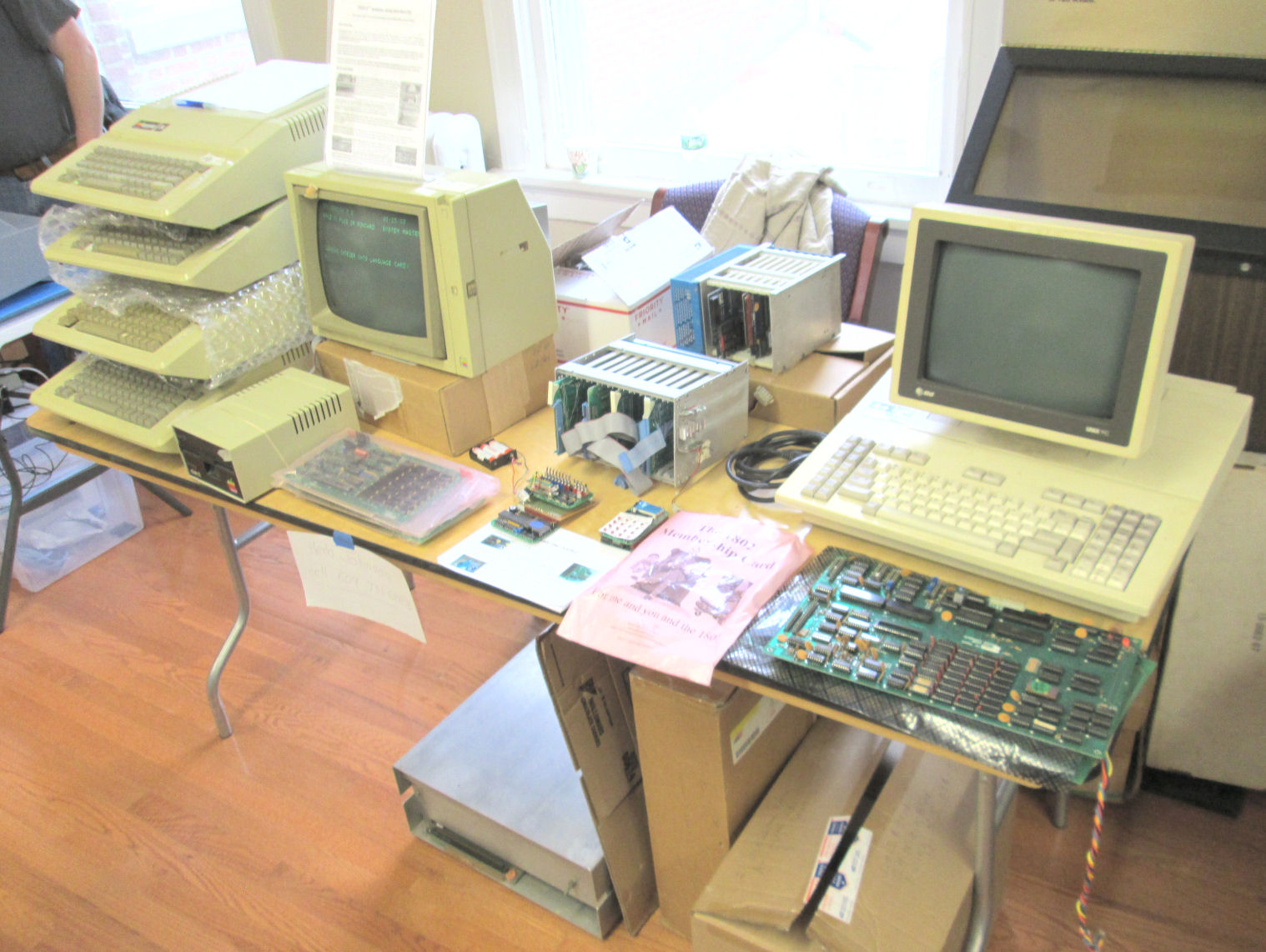
Apr 2017: I was a seller of vintage computers at VCF-East 2017 in Wall NJ. There were many vintage computing exhibits, and several vendors. Here's my table.
Mar 2017: I attended the 44th Trenton Computer Festival which had its vintage moments.
April 2016: I exhibited at the Vintage Computer Festival - East IX in Wall, NJ. I displayed my recent repairs of two Ithaca Intersystem DPS-1 S-100 systems and also selling the 1802 Membership Card of Lee Hart.
April 2015: I was a "dealer" at the Vintage Computer Festival - East 10.0 in Wall, NJ. I was selling
vintage computers, of course, plus the 1802 Membership Card of Lee Hart. The image shows an old laptop as terminal, operating the M/S card IDIOT monitor via serial port. The COSMAC 1802 Membership Card set, is about the size (and fits) an Altoids can.
April 2014: I exhibited at the MARCH/InfoAge Vintage Computer Festival - East 9.1.My exhibit showed some of the earliest Intel 4040 and 4004, and early RCA COSMAC microprocessor, development tools and products. Also, hobby electronics publications where early micro-computers were introduced. A chart of 1975 prices for common costs, and a PolyPaks ad of prices too. And, some modern COSMAC ELF products available recently and today.
In Feb 2013, I was one of several MARCH members invited by MARCH to exhibit vintage computers at the Trenton Computer Festival 2013. See my exhibit and others' vintage systems at the show on this linked page. I had to repair some of the items just before the show, or I repaired some later. The Heath H-8 computer, was mostly a repair of floppy drives. One of them, a Motorola 6800 D2 Evaluation Kit I got running a week later! About a month later, I got the ADM-3A with "bad characters" working.
In may 2012, I exhibited at the MARCH/InfoAge Vintage Computer Festival - East 8.My exhibit was a range of S-10 systems, namely Xitan, Dynabyte, Compupro, Zenith Z-110, Northstar. The Z-100 series system ran CP/M 80, CP/M 86 and MS-DOS. The Compupro included a Z80/80286 CPU board from Macrotech, and ran CP/M 80 and CP/M 86. S-100 systems in the early 1980's competed successfully with early IBM-PCs. Of course, the earliest S-100 systems were sold for years before that.
During April-May 2011 in preparation as a vendor at the Vintage Computer Festival - East 7.0, I showed and sold a restored Northstar Horizon; I show prior work on a Northstar Horizon I restored in 2007. Also at the same show, I showed a Polymorphics 88 computer I acquired in May 2011. I exhibited again in May 2012 at the Vintage Computer Festival - East 8.0, showing several S-100 systems again, most of them operating due to my work. And, in a June-July weekend in 2012, the MARCH club and Infoage sponsored a vintage computer repair event where I participated in repairing a PDP-8 and a Processor Tech SOL computer.
To repair old computers, you need testing equipment. In the 21st century, use and understanding of the simpler tools of the 20th century has become another "lost art". Many of these are available cheap and simple to learn about, if you apply yourself. Over time I'll build up some Web pages about electronic repair tools. I have some test equipment available for sale. Here's a Web page about a vacuum tube tester from Heathkit that I repaired. I also got another small tube tester, a Precision 954G tube tester, that I also acquired and fixed.
Sometimes vintage computers need vintage IC's, but ome IC's aren't as they are marked. They are re-marked to make them appear to be newer, older, faster; or aren't at ALL as marked. Read the linked Web page about "counterfit ICs" and see there's degrees of deception.
Some people get hung up on finding "experts", to "help" them or for other reasons. Some don't want to sit down and study the old computer books and manuals and software. I have a page which responds to issues about "experts" and "study". Hint: you gotta do your homework. Sorry.
Here's some component-level repair notes I'm accumulating. Search my Web domain for other repair tips and problem-solving.
I have a Web page on vintage computer museums and archives which support restoration. For the MARCH vintage museum, I developed an exhibit of a DEC PDP-11/20 system with ties to the US Census Bureau and text recognition. While working with MARCH, I worked on their Calcomp plotter, my own Calcomp plotter, and got help from other plotter owners.
Some people create new hardware, or replicate old hardware, using "vintage" components. Most digital components from the 1970's are still avaiable today, some in modern use. And, it's cheaper than ever to produce digital circuit boards, even a few at a time. Check this Web page about people who offer new hardware designs, or replicas of old designs, for old computers.
Here's an example of a "redo" of a classic old computer. My old friend and electronic designer, Lee Hart, was discussing a 30-year-old microprocessor design a few years ago. I bugged him into making his ideas into a kit. I've sponsored and written the Web pages about how he did that, and built one. It runs the RCA 1802 processor, developed in 1975 and used by NASA to run the Galileo spacecraft to Jupiter. See how Lee Hart and his Cosmac friends re-developed the classic Cosmac Elf design into an Altoids-can-size "membership card" computer.
In the course of reviewing the development history of CP/M by Dr. Gary Kildall of Digital Research, I discussed the earlist floppy controller which ran CP/M. This linked Web page describes the Digital Systems controller, down to tools to read the microprogram PROMS of the microcontroller that supported those early Shugart 8-inch drives! These and related pages represent what it takes to document a 35-year-old digital design.
I've re-developed some simple cross-assemblers because I wanted C-sources that I and others could adjust to meet various needs. The A18 is a C-source COSMAC 1802 cross-assembler, one of many versions for other processors. Another cross-assembler I provide is ASMX from Bruce Tomlin.
I have many Web links to S-100 and CP/M related Web sites, in my S-100 and CP/M Pointers Web page. Also look at my CP/M how-to Web page, for restoring or adding CP/M to a vintage system.
Most of those microcomputer systems used floppy diskette drives for file storage; see this Web page for technical support for floppy drives. However, some of them used audio cassettes for data storage: see my Web page about audio cassette digital storage technology, for links to specific technical and per-brand information.
Those pages are part of my general support for S-100 systems of the 1970's and 80's; and my review of early CP/M development in the early 1970's.
Of course my "retrotechnology.com" Web site provides general support for the use of old technology, such as the technologies I've mentioned here.
Copyright © 2025 Herb Johnson