![[11/20 front panel]](11_panel_2.jpg)
Page created Oct 7 2007. Last edit Oct 27 2015. This material was licenced from MARCH by me, the author and publisher, Herb Johnson. The MARCH organization ended and assets donated to the Vintage Computing Federation Inc.
Introduction:
Introduction to the Greenough 11/20 collection
museum PDP-11/20 exhibit
PDP-11/20 virtual exhibit
Questions about the system and collection:
Who first owned the original system?
What was sold with the 11/20?
How was it used and programmed?
How was the 11/20 operated?
Can the 11/20 be restored and run today?
Related Web pages:
the PDP-11/20 virtual exhibit
Greenough's history with FOSDIC and the 11/20
Exhibit development history
Contributors to the exhibit
Web links for more information
Contacts and Web sites
In August 2007, the MARCH vintage computer club of InfoAge in New Jersey acquired a PDP-11 system of some sort. When I came by to help them set up rooms for new exhibits and storage, I saw the system and saw that it was an 11/20, with a largely COMPLETE collection of manuals, schematics, and even the paper-tape operating system. I saw right away that this could be the basis for an exhibit of 1970's "state of the art" for DEC minicomputers, even without running the system. I also saw that I could create this exhibit as an exhibit example for InfoAge and MARCH. After some consideration and encouragements from MARCH members, Evan agreed and I began work.
I soon found that this system was part of document scanning systems developed by the US Government's National Bureau of Standards (NBS, now NIST) from the 1950's through the 1990's. This particular system was donated by M. Leighton Greenough, who developed systems used those systems at NBS and later as a consultant. He eventually purchased it and continued to do similar scanning work for the US government. Mr. Greenough was kind enough to write a description of his history with these system and provide photos, which are now shown and discussed on this Web page. This particular PDP-11/20 was used for evaluation of experimental scanning techniques and not for production scanning.
This 11/20 donation includes the original 1969 distribution of DEC's paper tape operating and development system, including paper tapes and manuals. A description of the DEC paper tape software system and its console of switches and lights, is on the Web pages linked in this section. Documents, boards, paper tapes, the contents of the 11/20 itself, were listed and photographed. The history of this and related systems at the NBS, with photos, was provided by Mr. Greenough himself. Others provided related artifacts, and videos to display operation of a papertape programming environment like the 11/20's. I produced a set of Web pages (this is a subset) and the exhibit posters and the exhibit displays. David Gesswein of pdp8.net produced videos of operating a Teletype, and operating a PDP-8, an earlier DEC computer with similar front panel.
The exhibit was shown for a few months in 2008. Here's a Web version of the PDP-11/20 exhibit.
Contributors to the exhibit are described on this linked Web page. There is also a history of exhibit development on that page.
- Herb Johnson
On September 13 and 14 2008, the MARCH vintage computer club of InfoAge had a computer show "VCF-East", and the public opening of their new public museum facilities at InfoAge, a science and education center on the New Jersey shore. The PDP-11/20 described here was one of many computing exhibits. My thanks to several people for their work and contributions. The posters in the exhibit are based on the contents of these Web pages. We also created a set of Web pages to support the exhibit (these 11/20 Web pages are a subset); a modern computer was part of the exhibit to show those pages and some videos.
Here is a representation of the PDP-11/20 exhibit, as a set of HTML and image documents. These Web page show images of the artifacts and posters for the exhibit. The images have links to larger images, documents, etc. of the actual exhibit. The actual exhibit of 2008 included these Web pages and videos, on a Linux system which displayed them and the videos. This "virtual" exhibit amounts to a tour of the actual physical exhibit. I regret that MARCH chose to produce the posters at half the expected size: consequently they looked busy and crowded.
In October 2008, MARCH was given copyright and a copy of all work done on the 11/20 exhibit. I have a non-exclusive license to use the work I did. MARCH is responsible for any further work on the artifacts and the exhibit. As of 2009, MARCH still exhibits the 11/20 and one or two posters as provided. They did not host the provided Web pages, and don't show the videos produced. In 2012 and 2013, MARCH members began to work on the 11/20. It operated briefly from the front panel but apparently needs further testing and work as of 2013.
Herb Johnson
MARCH was the Mid-Atlantic Retro Computing Hobbyists until Oct 2015, with facilities at the InfoAge Science Center in Wall, New Jersey USA. In Oct 2015 MARCH dissolved as a corporation and user group, and assets transfered to "Vintage Computing Federation Inc." Physical assets were retained by VCF at the InfoAge location. David Gesswein of pdp8.net produced and provided a number of demonstration videos. Some of these appear on his Web site, which supports PDP-8 computers and related peripherals and devices. David also provided display artifacts for the exhibit. Many thanks.
This and the other 11/20 exhibit pages were written by Herb Johnson. Herb's Web site is at retrotechnology.com To contact Herb Johnson, check his home page at retrotechnology.com. Herb has
several DEC computers, check his DEC home page for details.
The PDP 11/20 Exhibit
Contacts and Web sites
The Vintage Computing Federation Web site is at this link.
The InfoAge Web site is at this Web link.
Questions about the system and collection
![[11/20 system and docs]](dec_n_docs.jpg)
"This machine was bought by the National Bureau of Standards in the early 1970s for a project I was working on. I modified it a bit to create an interface to a flying spot scanner. After some use it was declared surplus upon my retirement in 1976. A year later the U.S. Postal Service Research Laboratory acquired it and commissioned me to modify the scanner for their work. A memory expansion unit was there added. In 1986 the USPS no longer needed the equipment and accepted my unsolicited bid for purchase of the entire system, including the computer, scanner and other associated equipment. The computer has been on a shelf in my house ever since. Now I would like to find a good home for it." - Leighton Greenough
In a later communication from Greenough, he affirms that "although incorporated in a system compatible with [Census] specialized documents, [this computer] had no connection with [the Census Bureau] beyond evaluation of experimental scanning techniques."
Components available and condition (from Greenough)
Main chassis without power supply , in rack mounting
Power supply for above, H720e
Expansion memory: Plessey 1116 B, Core (16k, 16-bit words)
Bus cables: 6, 9 and 15 feet
Boxes, approximately 15x22x4 (2) of manuals
Boxes of DEC (in trays) and custom programs
Miscellaneous DEC circuit boards
There is no Teletype console
Main computer chassis is in apparently excellent condition. The power supply (included) has been separated from the main chassis for convenience in handling.
Mr. Greennough obtained the 11/20 when he retired; he donated it to the MARCH museum in 2007.
Three boxes of paper tapes (two sets of DEC system stuff, some DECUS stuff);
two boxes of manuals (about two sets)
box with core memory module, Plessey Microsystems PM-1116-B ? with manuals
box with Unibus cables
white binder of manuals
two external power supplies (one in box)
The boxes have old lables such as "manuals from NEWMAN, 1977"; "paper tape programs from USPS Mach. FOSDIC VI". As of Aug 3 2008, the boxes have yellow Post-it notes saying "11/20 Greenough".
A detailed but partial inventory of the hardware, software, manuals and paper tapes was done and made available to MARCH in 2007-08.
![[inside of 11/20 bus]](11_cardcage2.jpg)
<-----------(bus cabling, M920 jumper blocks, resistive terminators) ---------->

     G225 M1091    	     G225 M1091		                  		             	M825 M823

H207 G226 G226 M7290	H207 G226 G226 M7290	M792 M780 M824 M822	M224 M820 M725 M724	M726 M728 M727
                   	                   	 YA

     G102 G102 M7290	     G102 G102 M7290	M792 M780 M824 M822	M224 M820 M725 M724	M726 M728 M727
                  	                   	 YA

     G102 G102     	     G102 G102    	M792 M105 M225 M821	M224 M820 M725 M724	M726 M728 M727
                   	                   	 YA

H207 G226 G226 G103	H207 G226 G226 G103	M792 M7820 M225 M821	M224 M820 M725 M724	M726 M728 M727
                   	                   	 YA
PDP-11/20's like this system, with optical and other equipment, was developed and used by the NBS in the 1970's, to scan documents for the National Census. In the 1980's they did similwar work for the US Postal Service. This particular computer was used for development and experimentation. A description of the history of the NBS FOSDIC system line, with photos of use, was provided by the original developer. That history was put on one of the developed Web pages of the exhibit for MARCH. A subset of that Web page is at this link.
The NBS or National Bureau of Standards, is now the National Institute of Standards and Technology (NIST) at nist.gov. NBS and NIST research provided technological leadership in many areas, and also established and maintains standard measures. A general description of how they developed massive optical scanning technology such as FOSDIC for the Census Bureau is at this link.
Programmers studied DEC's "PDP-11 Handbook" to program the 11/20, to operate its elaborate console or front panel, and to use the programming tools sold with it. Exerpts from that handbook were typed and provided as Web pages for the exhibit.
This chapter is the Introduction
The components of the PDP-11 were in this chapter
Use of the front panel or console was described in this chapter
This chapter described the Paper Tape Operating System, the manuals and paper tapes which are in our collection. See the "inventory" for a list of them.
To program the 11/20, the minicomputer had to be powered up, and programs loaded in. Initial loading, as well as diagnostics and tests, were done through the front panel. Then programs were loaded from paper tape or hard disk. The computer was often operated from a Teletype, a printing terminal. The section on "operation" describes these methods and devices.
The 11/20 computer itself has no programs in it, not even programs to read programs from devices like the Teletype or disk drives. To load the first programs when the computer is started up, the "console" front panel was often used; the console is also a diagnostic tool for repair and maintenance. A small program called a "boot loader" could then load other programs from those devices. Programs had to be loaded in, one at a time; the program was run, maybe producing a result which was output. Then another program was run, and another, and so on. For applications like the FOSDEC, where the same program was always used, the "loader" programs would be stored in ROM (fixed memory), and they'd load the appropriate programs from disk.
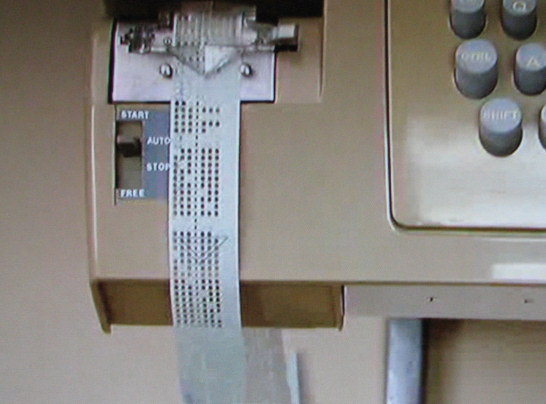
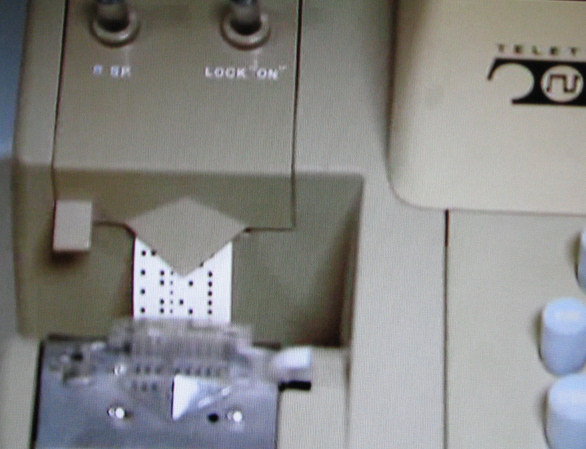
![[paper tapes]](exhib_tapes.jpg) Otherwise, for program development, the PDP-11/20 was often sold with a Teletype, a printing terminal with its paper-tape reader and punch. Optionally the 11/20 could have a Remex brand high-speed paper tape reader and punch. "Paper tape" contains data and programs; it has sets of 8 holes in rows, and are read or punched by rows to represent "bytes" of data or a single character of text in "ASCII" code. In the era of the 1960's, before hard drives were common and before floppy drives were available, paper tape was sufficient to hold modest amounts of data and programs.
Otherwise, for program development, the PDP-11/20 was often sold with a Teletype, a printing terminal with its paper-tape reader and punch. Optionally the 11/20 could have a Remex brand high-speed paper tape reader and punch. "Paper tape" contains data and programs; it has sets of 8 holes in rows, and are read or punched by rows to represent "bytes" of data or a single character of text in "ASCII" code. In the era of the 1960's, before hard drives were common and before floppy drives were available, paper tape was sufficient to hold modest amounts of data and programs.
DEC provided a "Paper Tape Operating System" with this PDP-11/20 from 1969-70, as discussed above. Later, DEC developed other operating systems and programming languages for the PDP-11 series.
The PDP 11/20, like many minicomputers of the 60's and 70's, had a "front panel" called a console which was used to access the computer and program it at the binary (bit) level, one memory location and one instruction at a time. Our 11/20 console is described in detail in the "console" manual exerpt described above.
David Gesswein produced a video of starting up a similar computer, the PDP-8. Here's a Web link to my description of that video, which has a link to his video on his WEb site.
![[tty session]](video_ttysession.jpg)
It was common to operate the early PDP 11's with a Model ASR-33 Teletype. This was a person-operated printing terminal with keyboard, which could also read and produce paper tapes. As described above, these tapes provided data and program storage. The Teletype printer is controlled by either the paper tape reader, or data input on the Teletype serial line. The Teletype keyboard, or the Teletype paper tape reader, sends data output on the Teletype serial line. "Serial" means the binary data is sent on a single wire, bit by bit and byte by byte, in a sequential or "serial" fashion.
For the exhibit at MARCH, David Gesswein of pdp8online.com produced videos of a Teletype operating as described above, but with a DEC PDP-8 system. Those videos and descriptions are on his PDP-8 Web site on this Web page. Thank you, David, for your work.
On his Web site, check the video "PDP-8/I Disk Monitor System Session. This linked document is a description of what David is doing in that video, step by step, to run a program using paper tape and the Teletype, on his PDP-8. This is similar to what would be down with the PDP-11.
Other videos on that Web page show paper tape handling - reading and writing - on the Model 33. The model 33 can "read" the paper tapes it punches, or other tapes. The tape is fed over the reader, which has a spiked wheel to pull the tape over the reader. The small line of holes in the center of the tape are the "feed holes". When the tape contains text, Teletype printer can print that text. The model 33 Teletype can also write or "punch" a paper tape with an ASCII or binary pattern of eight bits at a time.
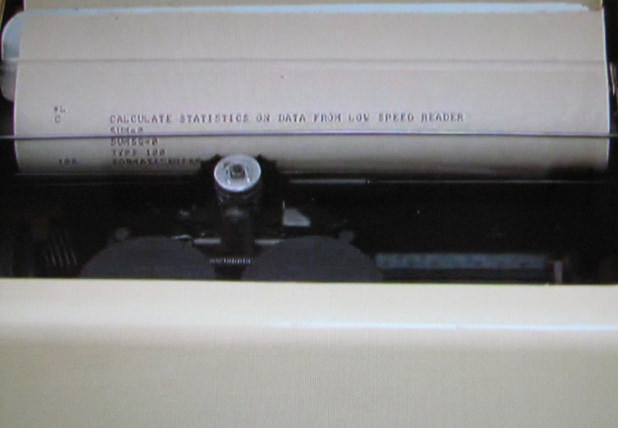
The operator uses the Teletype's keyboard, printer, tape punch and tape reader to interact with the PDP-11/20. The Teletype prints text, either as received from the serial line, or "echoed" from the keyboard, or from ASCII text read from the paper tape reader.
It takes considerable skills, electronic tools, and experience to restore a forty-year-old computer to full operation. That includes knowledge about technolgies no longer in use, and skills to repair digital and analog electronics down to resistors, capacitors, transistors and integrated circuits. One example of such work today is David Gesswein's PDP-8 collection of running computers. Here is a link to an example of one of his repairs..
That said, these 1970's computers were designed for a long life of use and for repair to the component level. In the 21st century, many DEC computers of this vintage are restored to operation with surprisingly little component work needed. Boards become available through online sales and offered in DEC-related discussiong groups on the Web. It's still a challenging task to restore and operate one of these computers.
Sometime in 2012-13, members of MARCH cleaned up the 11/20 and made it operate as shown here, no peripherals added. No serious damage to components had occured. HOwever some faults occurred and the 11/20 was not fully functional. It's likely more attention to it, could restore it to operation, and peripherals added for use.
DEC was purchased by Compaq Computers. Compaq was purchased by HP. In 2008, all I could find on HP's corporate site, was references to Compaq. Some of their pages reference DEC systems of the 1990's and later, which are or were supported "recently".
There are many Web sites devoted to DEC's minicomputers of the 60's and 70's and beyond including the PDP-11 line of minicomputers. They offer far more support and description than these Web pages. A Web search will find them.
Thanks to David Gesswein of pdp8online.com for permission to use these videos, which he produced. He created new videos and text descriptions in 2008, to support this exhibit and Web page. The PDP 8/I and ASR-33 Teletype are owned, maintained and described by him. These and other videos are on his Web site.
There is a Web archive site which links to other archive sites which have manuals on-line. The MANX Web site has its own database, to provide links to some of the on-line manuals for the PDP-11/20.
Some Web sites with information about DEC boards such as those in the PDP 11/20 are:
a field-guide list of DEC modules
by function is at this site
and the module list is also at this site
Schematics per board are at
a mirror of the former pdp12.org Web site.
To contact Herb Johnson, check my home page at retrotechnology.com.
Copyright this document: © 2023 Herb Johnson. Other 11/20 exhibit materials were copyrighted © to the former MARCH organization in 2008, as produced by Herb Johnson at that date; with rights of use by Herb Johnson. The MARCH organization ended and assets donated to the Vintage Computing Federation Inc.