![[Zenith Z100 system]](z100hp.jpg)
this page last updated Aug 8 2012. (c) Herb Johnson 2011.
This Web page displays and discusses some Heath/Zenith Z-100 technology. I have parts, docs, cards for these systems and other older Heathkit computer systems available: check my Heath old computer section for what I have in Heath/Zenith stock. another Web page. Refer to my
Ordering information and how to email @ me can be found in this notice.
Other related Z-100 Web pages:
The Heath Company had a long history, from selling WW II surplus to selling computers in the 1980's and 90's. I have a capsule description of recent "Heath/Zenith" history on my Heath/Zenith Web page.
The Z-110 model without internal CRT is generally called the "low profile" model, without an internal CRT monitor; the Z-120 or "all-in-one" model had a internal monochrome CRT monitor (which many updated to color). A Zenith external 8-inch floppy drive system in pictured in my disk drive section
Brief specifications of the Z-100 series is: a S-100 or IEEE-696 standard motherboard backplane but with on-board dual processor (8088 and 8085) and memory (256K or 768Kbytes), and "daughterboard" video (32K or 64K of RGB color or monochrome). S-100 cards from Heath included a floppy disk controller, additional memory, a hard drive controller, 4-port serial card. Many other S-100 companies offered add on cards.
These systems were bought by the US military for training, and a number of universities bought them or required them for students. These are very reliable and rugged systems; many were still in use into the 21st century. Some still appear at military or research surplus auctions.
Both systems contain a six-slot S-100 motherboard with integrated I/O, memory, and dual 8088 and 8085 processors, along with up to 768K of memory. The 6-slot bus typically held a floppy controller card a hard disk controller card, and other cards. The floppy controller was standard and could support both 5.25 inch drives internally, and 8-inch floppy diskette drives externally. The packed shipping weight of the Z-110 "low profile" system would be about 55 lbs.
The Z-120 system "high profile" or "all in one" included a monochrome
CRT built into an add-on cabinet which mounted atop the same system as the Z-110. The Z-110 and Z-120 were collectively referred to as "the Z-100".
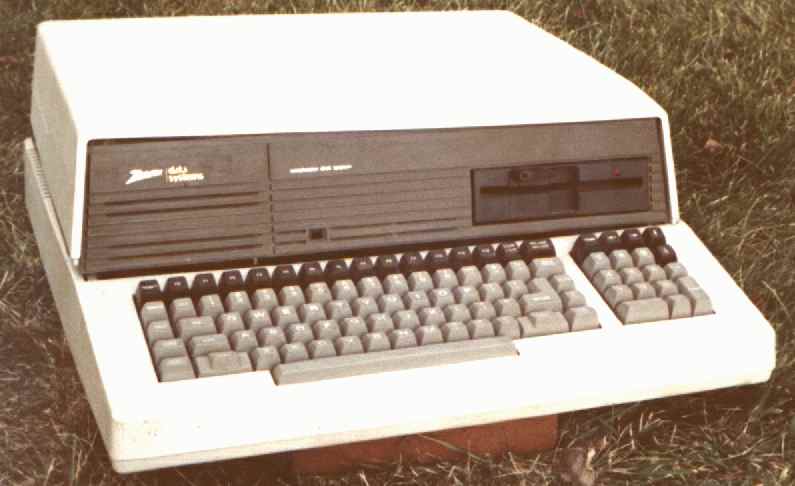
The Z100 is featured here, but the Z-120 is the same system with a CRT monitor inside an addition to the low-profile case.
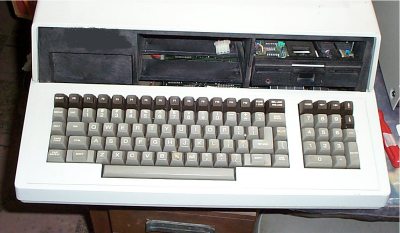
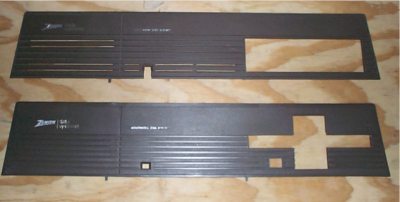
The front of the Z-110 shows the keyboard and the 5.25 inch drives. This unit has one 5.25 inch floppy drive on the right, and an opening on the left for another drive (either hard drive or floppy). The front panel has been removed for convenience. The Z-110 and Z-120 design supported one or two internal floppy drives and so had has a number of different front panels accordingly. (It also supported up to four external 8-inch floppy drives via a 50-pin connector.) The keyboard's keys are independent key modules which can be desoldered and pulled out of their circuit board for replacement.
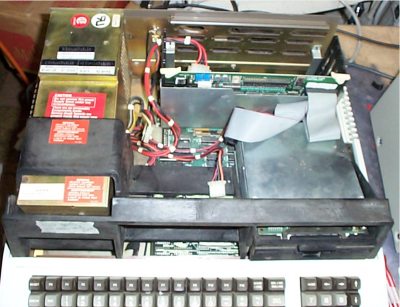
The interior of the Z-100 contains the switching power supply on the left, and on the right the S-100 motherboard and bus to the rear, with the drives seated in a frame above the video card and the motherboard. "S-100" refers to the 100-pin bus card that is inside the Z100 the IMSAI and other such systems. In particular, the H/Z 100 has the IEEE-696 version of the S-100 bus. Here's a a list of various S-100 bus lines by manufacturer including the IEEE-696 bus.
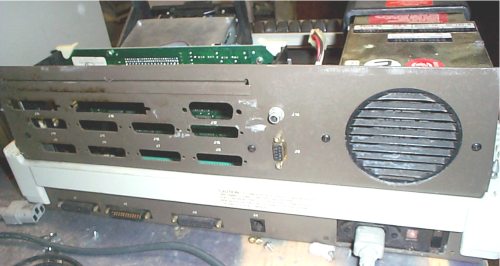
The back of the Z-100 has a number of cutouts for connectors to serial, parallel, and floppy drive cables. Most of these cutouts can be covered with plastic caps if not in use. The bottom of the case has the standard connectors which extend from the Z100 motherboard. They include serial and parallel connectors. The telephone like connector is I believe an alternative for the keyboard. At the right are the A/C cable and power switch. Above those is the circular opening for the power supply's fan. Just to the left of that opening is an RCA and DB-9 connector, for composite B/W and RGB color video, respectively.
If you remove the top and look behind the back, you get a view of the S-100 bus card cage. This system has the floppy disk controller card in place near the "front" of the card cage; you can see the S-100 connectors behind it. And, in front of the card cage, the image shows some of the power cables for the floppy drives and the hard disk controller card. The hard disk controller is actually two cards, one in the S-100 slot and one mounted above the hard drive, which has its own power cable.
![[Zenith Z100 buscard]](z100bdx.jpg) Here's a
closer look at the motherboard, and check the image on the right! The far right of the card as shown is mounted at the back of the Z-100, that's the S-100
bus connectors. The left edge of the card mounts underneath the Z-100 keyboard, and contains
the memory area (three parallel rows of chips) and some of the logic chips which provide
the features and "glue" together the major chips of the Z-100 system. When this system
was designed and built, highly-integrated logic (VLSI, gate arrays, etc.) were not
available; so system functions were built up from seperate large chips (CPU, video,
floppy controller, etc.) and smaller chips provide logical connections or additional
functions, and a few PAL (programmable array logic) chips provided some custom logic.
Here's a
closer look at the motherboard, and check the image on the right! The far right of the card as shown is mounted at the back of the Z-100, that's the S-100
bus connectors. The left edge of the card mounts underneath the Z-100 keyboard, and contains
the memory area (three parallel rows of chips) and some of the logic chips which provide
the features and "glue" together the major chips of the Z-100 system. When this system
was designed and built, highly-integrated logic (VLSI, gate arrays, etc.) were not
available; so system functions were built up from seperate large chips (CPU, video,
floppy controller, etc.) and smaller chips provide logical connections or additional
functions, and a few PAL (programmable array logic) chips provided some custom logic.
Z-100 motherboards came in two models. The model 85-2653-1 supported 192K RAM as three sets of 64Kbyte chips. The model 85-2806-1 support 768K RAM as three sets of 256Kbyte chips. There were many versions of the ROM monitor and test program; some versions came from Heath/Zenith, and some unofficial versions were created long after the Z-100 was out of production.
The Heath/Zenith Z-100 was one of the few S-100 systems that came into modest production - large by that era's standards. The US military bought many for use in training and military education. A few universities bought these systems for campus use and encouraged their students to buy these. For many years, there was a regular supply of these as surplus from the military or these schools. Even in the 21st century, I get emails from former students or officers, offering the the systems they used back then!
here's my Web page on repairing my own Zenith Z-110 systems in 2009.
The common name for the system shown above was the "low profile" Z-110. That is in contrast to a version with identical features and hardware, but with a B/W monitor mounted above the motherboard and power supply. This "high profile" Z-120 system moved the two drives to the right of the monitor. The monitors came in green or white; some people found RGB color monitors to swap into these systems. Other than the monitor, its cabinetry and a slightly larger power supply, the two systems were identical.
The Z-100 was not a PC compatible system; in fact the design most closely resembles the Compupro 8085/88 dual processor system. However, it did run ZDOS, a form of MS-DOS, as well as CP/M and could run many program common to MS-DOS "IBM-PC" systems. Many programs were adapted to run on the Z-100, and sold by Zenith and other companies, which also ran on the IBM PC. In addition, a company offered the "Gemini" board which provided additional IBM-PC compatiblity. This board mounted atop the Z-100 motherboard, and could be activated at boot time by selecting the Gemini over the Z-100 ROM monitor. We have some Gemini boards, check my Heath/Zenith page or ask.
![[Zenith floppy drive]](zenithfd.jpg) Here's a Zenith dual eight-inch floppy drive subsystem: these are occasionally available
from me. This box holds two half-height 8-inch floppy drives
or, in earlier times, one "full height" 8-inch floppy drive. The name "8-inch" means
the diskettes were eight inches in diameter. That size was the same as the diskettes
used in minicomputers and some mainframes of the 1970's and 1980's. IBM provided the
earliest 8-inch drives and set the "standard" for the very first commonly available
diskettes. A famous early manufacturer of 8-inch drives was Shugart Inc.; the founder
by that name later founded Seagate Inc. and Seagate continues to produce hard drives
today (2003). I have a lot of discussion about floppy drives on this page.
Here's a Zenith dual eight-inch floppy drive subsystem: these are occasionally available
from me. This box holds two half-height 8-inch floppy drives
or, in earlier times, one "full height" 8-inch floppy drive. The name "8-inch" means
the diskettes were eight inches in diameter. That size was the same as the diskettes
used in minicomputers and some mainframes of the 1970's and 1980's. IBM provided the
earliest 8-inch drives and set the "standard" for the very first commonly available
diskettes. A famous early manufacturer of 8-inch drives was Shugart Inc.; the founder
by that name later founded Seagate Inc. and Seagate continues to produce hard drives
today (2003). I have a lot of discussion about floppy drives on this page.
Ordering information and how to email @ me can be found in this notice.
Copyright © 2012 Herb Johnson